
Over the past 15 years, I’ve worked at the intersection of business and technology strategy. One thing is clear: even the best business strategy can falter if the tech doesn’t support it.
The way that technology is viewed on the strategic canvas, depends on the type of organisation. I have noticed that the more established businesses and traditional organisations with long history tend to view technology as no more than a support function.
"They're only here to serve us"
"They only exist because we provide funding to them"
I have noticed comments like these being made in businesses that either lack organisational maturity or those that have been in existence for several decades and usually enjoy a dominant position in the market simply because of the long-standing brand history. Such businesses tend not be progressive in nature and innovation in such companies is mostly concentrated in R&D and product development functions. Mostly, the brand strength and large market-share keeps such businesses afloat.
At the other end of the spectrum, some start-ups and smaller businesses as well as certain new entrants involuntarily end-up adopting tech-last strategy due to budgetary constraints because other functions take the centre stage. The only exception of course, are the businesses whose primary product or service offering is in fact, tech itself.
Companies that are decent enough establishments and are positioned around the middle or bottom of the market-share, typically strive to find innovative ways to gain ground on the organisations ahead of them in the market-share league. Innovation is a common theme across such organisations and they tend to pay special attention to technological advances to gain leverage in today's growing digital age.
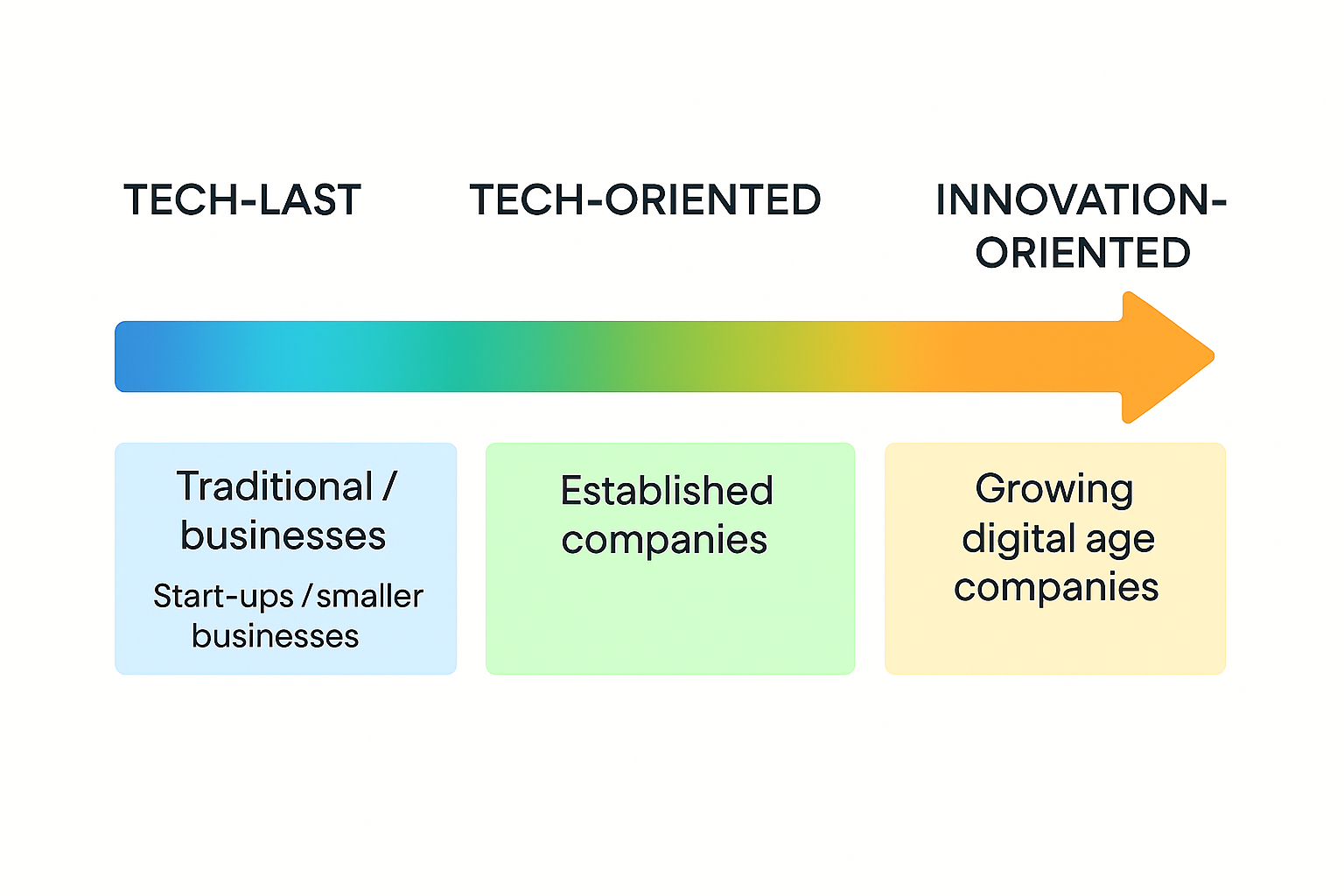
Navigating the Organisational Innovation Spectrum
In today’s rapidly evolving business landscape, organisations can be broadly positioned along a spectrum that reflects their relationship with technology and innovation. This image captures that continuum—from legacy-driven inertia to agile, innovation-first mindsets.
Tech-Last Organisations
On the left, we find traditional businesses and start-ups with constrained resources. These companies often adopt a tech-last strategy — not necessarily by choice, but due to entrenched legacy systems or budgetary limitations. Innovation tends to be siloed within R&D or product teams, while other functions operate with minimal digital integration. Their survival is often buoyed by brand equity or market dominance rather than forward-thinking strategy.
These companies often lag in digital adoption—not necessarily due to lack of awareness, but because of legacy systems, budget constraints, or market dominance that reduces urgency.
Examples:
- Kodak – Once a photography giant, Kodak’s reluctance to embrace digital disrupted its dominance.
- Blockbuster – Failed to pivot to streaming despite early opportunities, ultimately losing out to Netflix.
- Local SMEs & Traditional Retailers – Many small businesses and long-standing family-run firms still rely on manual processes and minimal tech integration.
Tech-Oriented Organisations
In the middle of the spectrum sit established companies that have embraced technology to a reasonable extent. These businesses may not be digital pioneers, but they understand the importance of tech in maintaining competitiveness. Their approach is often pragmatic — investing in systems and platforms that support operational efficiency, customer engagement, and incremental innovation.
These are established companies that have embraced technology to modernise operations, improve customer experience, and stay competitive—but innovation may not be their core identity.
Examples:
- Unilever – Digitally transformed supply chains and marketing, but innovation is incremental.
- IKEA – Invested in digital shopping experiences and smart logistics while maintaining its core retail model.
- Starbucks – Uses AI and mobile tech to enhance customer experience, but remains product-centric.
Innovation-Oriented Organisations
At the right are growing digital age companies — organisations that view innovation not as a department, but as a culture. These businesses are typically mid-market challengers or ambitious new entrants, hungry to disrupt incumbents. They leverage emerging technologies to create differentiation, accelerate growth, and adapt swiftly to market shifts. For them, innovation is a strategic imperative, not a luxury.
These companies treat innovation as a strategic imperative. They’re agile, tech-savvy, and often disrupt incumbents by leveraging emerging technologies.
Examples:
- Tesla – Constantly pushes boundaries in automotive tech, energy, and AI.
- Airbnb – Revolutionised hospitality through platform innovation and data-driven UX.
- Shopify – Empowers e-commerce entrepreneurs with cutting-edge tools and integrations.
This spectrum isn’t static. Companies can — and should — move along it as they evolve. The key is recognising where you are today and what it will take to shift toward a more innovation-oriented future.